

Motorcycle Tire Guide: Everything You Need to Know About Choosing, Maintaining, and Replacing Tires
November 17, 2026
Motorcycle tires are among the most important components of any bike. They are the only parts of your motorcycle that make direct contact with the road, which means they play a major role in traction, braking, cornering, stability, and overall riding safety.
Whether you ride a high-performance sportbike, a lightweight beginner motorcycle, a heavyweight cruiser, or an adventure touring machine, choosing the right tires can significantly affect your riding experience. However, selecting motorcycle tires isn’t simply about finding the correct size. You also need to consider tire construction, tread design, load capacity, speed ratings, riding conditions, and your personal riding style.
In this comprehensive motorcycle tire guide, we’ll explain the essential tire terminology, show you how to read motorcycle tire markings, and answer some of the most frequently asked questions about tire selection, compatibility, maintenance, and replacement. Let’s start with the basics.
Understanding Motorcycle Tire Construction and Terminology
Before shopping for motorcycle tires, it’s helpful to understand the different parts of a tire and how each one contributes to its performance. Here are four important motorcycle tire components you should know.
Tread
The tread is the outer surface of the tire that comes into contact with the road. Its design directly influences traction, handling, and performance under different riding conditions. Generally, motorcycle tires with relatively smooth tread patterns are designed for paved roads and provide excellent contact with dry surfaces. Tires with deeper grooves and more aggressive tread patterns are better suited to loose terrain, including dirt, gravel, and sand.
Different tread designs also offer varying levels of water evacuation, helping maintain grip when riding in wet conditions. When choosing a tread pattern, consider where you spend most of your riding time. Street tires, touring tires, and off-road tires are engineered for different environments.
Bead
The bead is the reinforced inner edge of the tire that sits against the motorcycle wheel rim. It generally consists of high-strength wire surrounded by rubber and other reinforcing materials. Its primary purpose is to keep the tire securely attached to the rim.
A properly seated bead helps maintain an airtight connection on compatible tubeless wheels and prevents unwanted movement between the tire and wheel during acceleration, braking, and cornering.
Carcass
The carcass is the structural body of the motorcycle tire beneath the tread. It provides the tire with its overall shape, strength, flexibility, and load-carrying characteristics. Motorcycle tires generally use one of three construction styles:
- Bias-ply tires: Their internal reinforcing cords run diagonally from one bead to the other, typically crossing at angles of approximately 30-40 degrees. Materials may include polyester, fiberglass, or aramid.
- Radial tires: Their carcass cords run across the tire from bead to bead, with reinforcing belts positioned beneath the tread. These belts are commonly made from steel or other strong materials.
- Bias-belted tires: These combine a bias-ply carcass with additional reinforcing belts to improve structural stability.
Each construction type offers different handling, comfort, durability, and load-carrying characteristics.
Sidewall
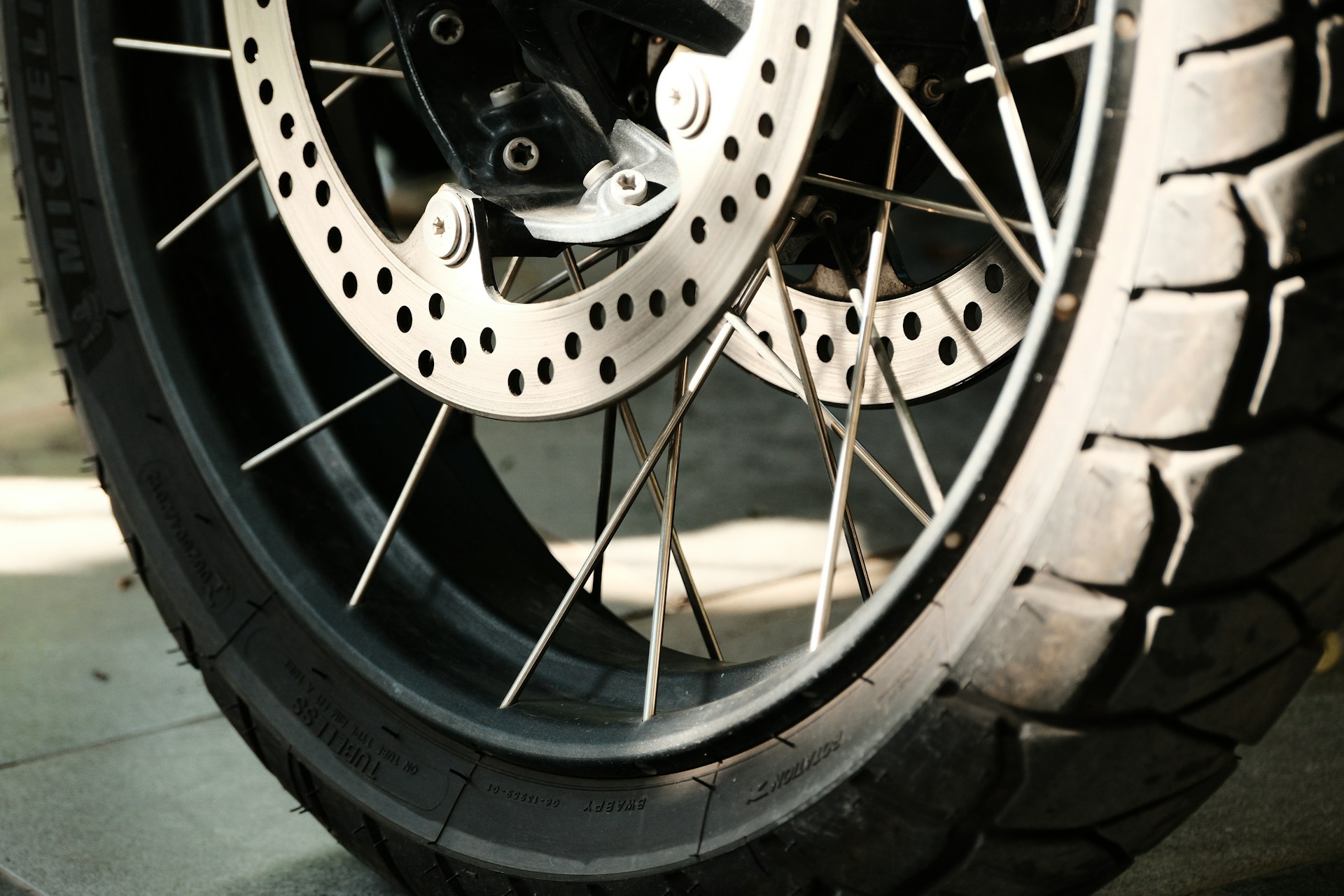
The sidewall is the section connecting the tread to the bead. Although it represents a relatively small portion of the tire, it has a considerable influence on motorcycle handling and ride comfort. The sidewall determines much of the tire’s flexibility and contributes to how the motorcycle responds to bumps, braking, acceleration, and cornering.
Its height is commonly described using terms such as profile, aspect ratio, or sidewall height. A shorter sidewall generally provides a stiffer feel and less flex, which can improve steering precision. However, it may also transmit more road imperfections to the rider and make tire installation more difficult.
Remember that motorcycle tires contribute to the suspension system by absorbing some of the impacts that would otherwise be transferred directly to the chassis.
How to Read Motorcycle Tire Sizes and Sidewall Markings
One of the most confusing aspects of purchasing motorcycle tires is understanding the numbers and letters printed on their sidewalls. Fortunately, these markings follow established sizing systems and provide valuable information about the tire’s dimensions, construction, and performance capabilities.
The two most common motorcycle tire sizing formats are:
- Metric tire sizing
- Alphanumeric tire sizing
Older motorcycles may also use inch-based tire measurements.
Understanding Metric Motorcycle Tire Sizes
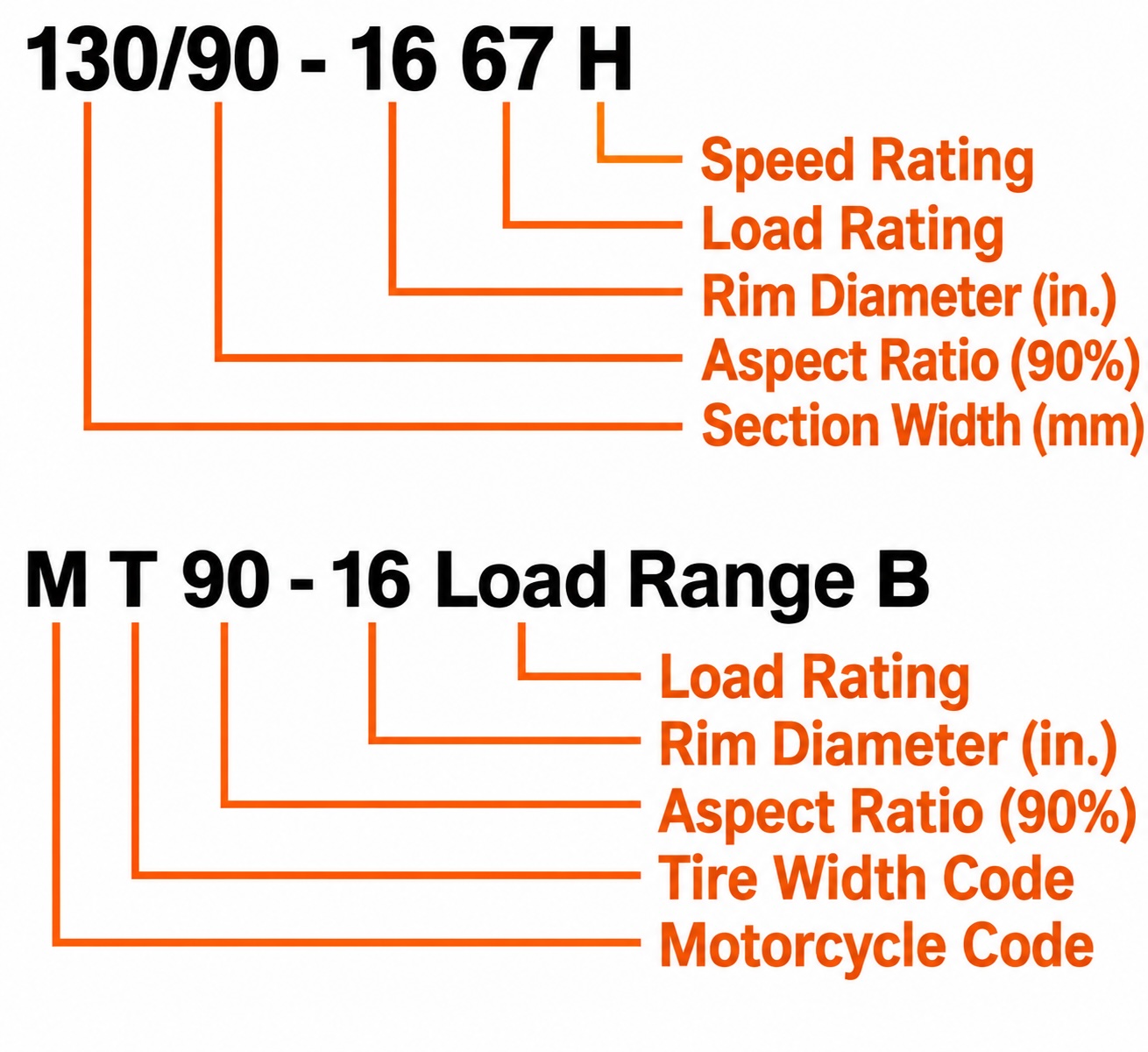
Metric sizing is the most widely used system on modern motorcycles. Consider this example: 130/90-16. Each section represents a different tire measurement.
130 – Tire width. The first number indicates the nominal width of the tire in millimeters. In this example, the tire is approximately 130 mm wide. Actual measurements can vary slightly between manufacturers because tread profiles and construction methods differ.
90 – Aspect ratio. The second number represents the sidewall height as a percentage of the tire’s width. For a 130/90 tire, the sidewall height is approximately 90% of 130 mm. That means: 130 × 0.90 = 117 mm.
16 – Wheel diameter. The final number indicates the diameter of the wheel rim in inches. Therefore, this tire is designed for a 16-inch wheel.
Understanding Tire Construction Letters
You may notice additional letters between the aspect ratio and wheel diameter. These letters identify the tire’s construction:
- R: Radial construction.
- B: Bias-belted construction.
- No letter: Generally indicates conventional bias-ply construction in this sizing format.
For example:
- 130/90-16: Bias-ply construction.
- 130/90B16: Bias-belted construction.
- 130/90R16: Radial construction.
Always verify the complete tire specification before purchasing.
What Does Alphanumeric Motorcycle Tire Sizing Mean?
Some older motorcycles and certain cruiser models use an alphanumeric tire sizing system. In this format, letters and numbers communicate the tire’s dimensions. The letter M commonly identifies motorcycle applications, while another letter represents the nominal tire width.
For example, a tire marked with an alphanumeric size may use the letter T to indicate its width category. Because these measurements don’t directly correspond to millimeters, it’s best to consult an official tire manufacturer’s sizing chart when comparing alphanumeric and metric dimensions.
Older Inch-Based Tire Sizes
Some vintage motorcycles use an older sizing format that expresses tire dimensions in inches.
A typical example is: 3.00 x 18
This indicates a tire approximately 3 inches wide designed for an 18-inch wheel. If your motorcycle uses this older sizing system, consult a specialist to identify suitable replacement tires. Modern metric equivalents are not always direct replacements.

Motorcycle Tire Load Ratings and Speed Ratings
Tire sidewalls also display load and speed ratings. The load index indicates the maximum weight a tire is designed to carry under specified conditions. The speed rating identifies the maximum speed at which the tire can safely operate when carrying its rated load.
Both specifications are essential when selecting replacement motorcycle tires. Never assume that a tire with the correct dimensions is automatically suitable for your motorcycle. Its load capacity and speed rating must also meet the manufacturer’s requirements.
How to Choose the Right Motorcycle Tires
Choosing suitable motorcycle tires begins with understanding your motorcycle and how you intend to use it. A tire designed for racing may not be appropriate for daily commuting, while a long-distance touring tire may not deliver the same characteristics as a dedicated sport tire.
Here are some common motorcycle tire categories.
Sport Motorcycle Tires
Sport tires are designed to deliver strong grip, responsive handling, and predictable cornering performance. They are particularly suitable for riders who prioritize acceleration, braking, and aggressive cornering on paved roads.
The trade-off is that some high-performance sport tires sacrifice tread life to achieve greater grip.
Touring Motorcycle Tires
Touring tires are engineered for riders who regularly cover long distances. Their design typically prioritizes:
- Long tread life.
- Consistent performance.
- Comfortable handling.
- Stability at highway speeds.
- Reliable wet-weather performance.
They are a popular choice for cruisers, touring motorcycles, and commuters who accumulate substantial mileage.
Sport-Touring Tires
Sport-touring tires combine characteristics from both sport and touring categories. They aim to provide a balance between cornering grip, handling, comfort, and durability.
For riders who enjoy spirited road riding but also travel long distances, this category can be an excellent compromise.
Adventure Motorcycle Tires
Adventure tires are designed for motorcycles that travel on both paved roads and unpaved surfaces. They are often classified according to their intended road-to-off-road usage.
Examples include:
- 90/10 tires: Primarily designed for asphalt, with limited off-road capability.
- 70/30 tires: Suitable for predominantly road-based riding with occasional dirt-road use.
- 50/50 tires: Designed to balance road and off-road performance.
- 30/70 tires: More heavily focused on off-road riding.
These percentages are general classifications rather than universal performance standards.
Why Original Equipment Specifications Matter
Although experimenting with tire sizes and designs can be tempting, the safest approach is to follow the specifications recommended by your motorcycle manufacturer. These recommendations normally include:
- Original tire dimensions.
- Appropriate construction type.
- Minimum load index.
- Required speed rating.
- Compatible front and rear tire combinations.
Changing any of these specifications can affect motorcycle stability, steering response, clearance, and overall safety. Unless a tire manufacturer explicitly approves an alternative, sticking with the original equipment specifications is the most reliable choice.
Motorcycle Tire Frequently Asked Questions
Even experienced riders have questions about tire compatibility and performance. Below, we’ll address some common concerns to help you make better purchasing decisions.
What Is the Widest Tire I Can Install on My Motorcycle?
There isn’t one universal answer because tire clearance varies considerably between motorcycle models. Installing a wider tire involves more than checking whether it fits between the swingarm.
You must also consider clearance around:
- The chain and sprockets.
- The swingarm.
- The rear fender.
- The suspension components.
- Other nearby motorcycle parts.
A wider tire may also have a larger overall circumference, potentially changing the motorcycle’s effective gearing and speedometer readings.
Another important consideration is tire expansion. As a tire rotates at high speeds, centrifugal forces and temperature changes can cause its dimensions to increase slightly. A tire that appears to fit perfectly while stationary might therefore rub against nearby components during operation.
Are Wider Motorcycle Tires Better?
Not necessarily. A wider rear tire does not automatically provide better traction, handling, or overall performance. Depending on the motorcycle and tire design, installing a wider tire can make steering slower and require more effort when leaning into corners. It may also increase rolling resistance and negatively affect fuel consumption.
Some manufacturers offer approved alternative sizes, commonly called plus sizing. These recommendations identify wider tire options that are compatible with particular wheels and motorcycles. Always check manufacturer compatibility information before changing your tire dimensions.
Can I Mix Radial and Bias-Ply Motorcycle Tires?
Radial and bias-ply tires have different construction characteristics, which can influence how a motorcycle handles. Radial tires generally offer:
- Lower operating temperatures in many applications.
- Reduced carcass flex.
- Improved stability at higher speeds.
- Potentially longer tread life, depending on the design.
Bias-ply tires generally provide:
- A more compliant riding experience.
- Strong load-carrying capability in many applications.
- Often lower purchase prices.
- Characteristics suited to certain heavyweight cruisers and touring motorcycles.
Some motorcycles are originally equipped with a bias-ply front tire and a radial rear tire. However, this doesn’t mean every combination is suitable. Always follow the motorcycle manufacturer’s approved tire configuration and the tire manufacturer’s compatibility recommendations.
Can I Replace Bias-Ply Tires With Radial Tires?
Switching from bias-ply to radial construction is not automatically safe, even when the tire dimensions appear identical. Different construction types can change the motorcycle’s handling characteristics, steering response, and load behavior. Only make this change when the motorcycle or tire manufacturer confirms that the alternative construction is compatible.
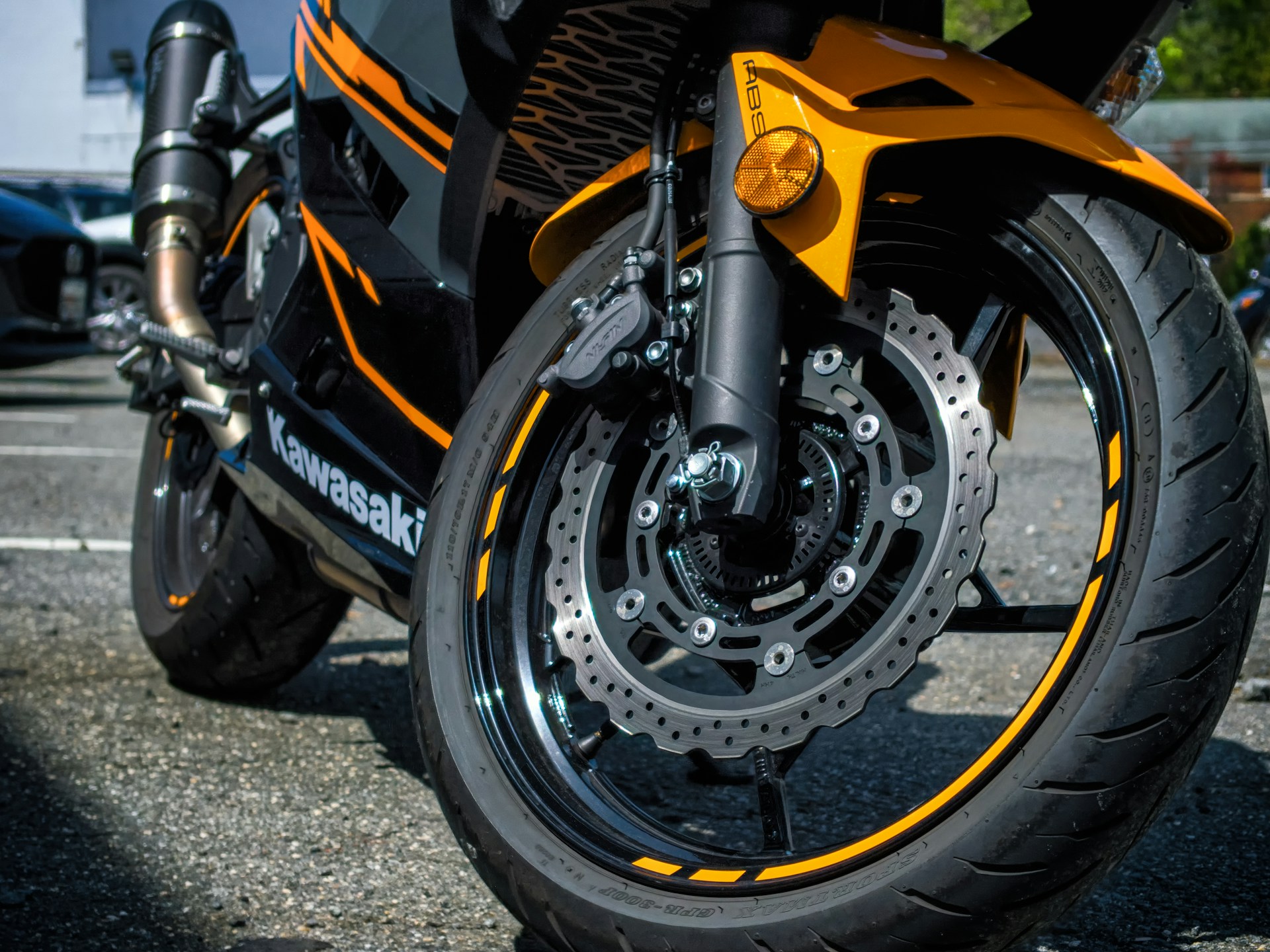
Can I Install a Tubeless Tire on a Spoked Motorcycle Wheel?
It depends on the design of the wheel. Traditional spoked motorcycle wheels generally require inner tubes because air can escape through the openings where the spokes connect to the rim. Some modern motorcycles use specially designed spoked wheels that maintain an airtight seal. Certain alloy wheels may also require tubes, particularly on older motorcycles.
Before installing a tubeless tire, check whether your wheel is approved for tubeless operation. Even if you find a way to seal a traditional spoked rim, the wheel may not provide the correct bead seating characteristics for tubeless use. For safety reasons, don’t convert a tube-type wheel without an approved conversion system and professional guidance.
Can I Put an Inner Tube Inside a Tubeless Motorcycle Tire?
In many cases, a compatible tubeless tire can be used with an inner tube when the wheel requires one. However, adding an inner tube introduces additional friction and heat inside the tire. This can affect the tire’s operating characteristics and may influence its load and speed capabilities.
Some manufacturers provide specific instructions for using tubes inside their tubeless tires. Always follow those instructions rather than assuming that every tubeless tire is suitable for tube installation.
Should I Replace Inner Tubes When Installing New Motorcycle Tires?
Yes. Replacing the inner tube whenever you install a new tube-type motorcycle tire is generally the best practice. Inner tubes deteriorate over time because of repeated heating, cooling, stretching, and normal aging. As the rubber becomes harder and less flexible, the risk of cracks, leaks, and sudden air loss increases.
Although an old tube may appear to be in good condition, its internal wear isn’t always visible. Considering the relatively low cost of replacement tubes compared with the potential consequences of a failure, installing a new tube is a sensible precaution.
For tubeless tires, inspect the valve stem and replace it when recommended by the manufacturer or tire installer.
What Size Valve Stem Does My Motorcycle Tire Need?
Motorcycle wheels commonly use two valve stem sizes:
- 8 mm.
- 10 mm.
The larger type is widely used on motorcycles from Japanese manufacturers and Harley-Davidson. The smaller type appears on certain BMW and Buell models, as well as some aftermarket wheels. However, these are general categories rather than universal fitment rules.
The correct valve stem depends on the actual diameter of the wheel’s valve opening and the valve design. Check your motorcycle’s wheel specifications before purchasing a replacement.
Can I Use Motorcycle Tires With Different Load or Speed Ratings?
Using a tire with a lower load index or speed rating than the manufacturer specifies is generally not recommended. Your motorcycle’s original tire specifications are selected to support its approved weight and performance requirements. Installing a lower-rated tire may compromise safety, especially when riding with a passenger or carrying luggage.
A higher load or speed rating may be acceptable when the tire is otherwise compatible, although a stiffer construction can sometimes affect ride comfort and handling. Keep the following weights in mind when checking load capacity:
- Rider.
- Passenger.
- Luggage.
- Accessories and additional equipment.
Remember that the motorcycle’s maximum permitted weight is determined by the manufacturer, not simply by the combined load capacity of its tires. Also, tire repairs may affect the manufacturer’s approved speed rating. Check the applicable tire manufacturer’s repair policy before continuing to ride on a repaired tire.
What Do Letters Such as B, C, and E Mean After a Motorcycle Tire Size?
These letters can form part of the tire’s service description or identify a particular tire version. A complete service description generally includes:
- A numerical load index.
- A speed rating represented by a letter.
Additional letters may identify construction differences or special versions designed for particular motorcycles. For example, some tire models use a B designation to indicate additional reinforcement or a modified construction.
Manufacturers may also produce special tire versions at the request of motorcycle manufacturers. If you encounter an unfamiliar marking, consult the tire manufacturer’s official specifications before making a purchase.
Can I Use Different Tire Brands on the Front and Rear?
Although some motorcycles leave the factory with different tire brands or models at the front and rear, mixing brands is generally not recommended unless the combination has been approved. Front and rear tires influence each other’s handling characteristics.
Differences in tread profiles, rubber compounds, construction, and grip can affect how the motorcycle behaves during cornering, braking, and acceleration. Many manufacturers develop specific front and rear tire combinations to work together. For the most predictable performance, use the recommended tire pairing for your motorcycle.
How Can I Check the Manufacturing Date of a Motorcycle Tire?
Motorcycle tires have a DOT identification code molded into their sidewalls. This code contains manufacturing and identification information. The final four digits are particularly important because they indicate when the tire was produced.
For example: 4224
This means the tire was manufactured during the 42nd week of 2024. The first two digits represent the production week, while the final two indicate the manufacturing year. Older tires manufactured before 2000 may have a three-digit date code. Because rubber compounds deteriorate with age, tire manufacturing dates should always be considered when evaluating tire condition.
A tire can have plenty of visible tread remaining and still be unsuitable for use because of aging. As a general precaution, have tires inspected by a qualified professional when they reach approximately five years of age. Tires around ten years old should generally be replaced, regardless of their visible condition, subject to manufacturer guidance.
Always check the tire manufacturer’s specific recommendations for age limits and inspection intervals.
Does Motorcycle Tire Age Really Matter?
Absolutely. Motorcycle tires are manufactured using rubber compounds that gradually change as they age. Exposure to sunlight, temperature fluctuations, humidity, and environmental conditions can accelerate deterioration.
Older tires may develop cracks, lose flexibility, and experience reduced grip. This is why checking the manufacturing date is just as important as inspecting tread depth. Never judge a tire’s condition exclusively by how much tread remains.
When Should You Replace Motorcycle Tires?
Knowing when to replace motorcycle tires is essential for maintaining safe riding conditions. Tire damage and excessive wear can reduce traction, compromise stability, and increase the risk of losing control. Here are some situations in which tire replacement should be considered immediately.
Signs That Your Motorcycle Tires Need Replacing
- Sidewall punctures: Damage to the sidewall generally makes the tire unsuitable for repair.
- Unrepairable punctures: Some punctures cannot be safely repaired because of their location or severity.
- Large punctures: Damage exceeding the manufacturer’s permitted repair limits requires replacement.
- Excessive age: Tires that have reached their recommended service-life limit should be replaced.
- Cracked rubber: Visible weather cracking indicates deterioration of the tire compound.
- Damage from low pressure: Riding with insufficient inflation pressure can cause internal structural damage.
- Cuts and slices: Deep cuts can weaken the tire and expose its internal structure.
- Missing tread blocks: Missing sections of tread can compromise grip and tire integrity.
- Insufficient tread depth: Tires worn below the applicable legal or manufacturer minimum must be replaced.
- Visible wear indicators: If the tread has reached its wear indicators, replacement is necessary.
- Uneven tire profiles: Excessive flattening or pointed wear can negatively affect handling.
- Severe cupping or feathering: Irregular wear patterns can cause vibration, noise, and unstable handling.
A damaged tire should always be assessed by a qualified professional. Although certain punctures may be repairable, not every repair is permanent or suitable for every riding condition. Because motorcycle tires are directly responsible for maintaining road contact, replacing a questionable tire is often the safer decision.
Why Is My Motorcycle Tire Vibrating, Wobbling, or Wearing Unevenly?
Not every motorcycle tire problem is caused by a manufacturing defect. Installation errors, incorrect tire pressure, worn motorcycle components, and wheel alignment problems can all produce unusual tire behavior. Here are some common causes.
Motorcycle Tire Chatter
Chatter refers to rapid vibration or bouncing that may be noticeable through the handlebars, footpegs, or motorcycle frame. Possible causes include:
- Uneven tread wear.
- Incorrect tire pressure.
- Tire cupping.
- Suspension problems.
- Wheel balancing issues.
A proper inspection is necessary to identify the underlying cause.
Motorcycle Wheel Wobble
A motorcycle that develops an unusual wobble may have problems involving its wheels, steering, suspension, or chassis. Common possibilities include:
- Incorrect wheel alignment.
- Bent axles.
- Worn wheel bearings.
- Incorrect tire installation.
- Wheel imbalance.
- Loose steering components.
A wobble should never be ignored, particularly if it becomes more noticeable at higher speeds. Stop riding if the motorcycle feels unstable and arrange a professional inspection.
Uneven Motorcycle Tire Wear
Uneven wear can develop when a tire operates outside its recommended conditions. Potential causes include:
- Incorrect inflation pressure.
- Improper wheel alignment.
- Worn suspension components.
- Incorrect wheel installation.
- Riding conditions and habits.
For example, tire cupping can create alternating high and low areas across the tread surface. This may result in increased road noise, vibration, and reduced handling comfort.
How to Diagnose Motorcycle Tire Problems
If you suspect something is wrong with your tire, gather as much information as possible before seeking professional assistance. Useful details include:
- Motorcycle make and model.
- Tire brand and model.
- Tire size and manufacturing date.
- Current inflation pressure.
- Date and details of the last installation.
- Description of the problem.
- Photographs showing the affected areas.
These details can help a technician identify potential causes and determine whether the tire needs replacement or another motorcycle component requires attention.
Are Track-Day Motorcycle Tires Suitable for Street Riding?
If you enjoy aggressive riding, you might be tempted to install dedicated track-day tires on your street motorcycle. However, track tires are not necessarily the best choice for public roads. The main difference comes down to operating conditions.
Track Tires Require Specific Operating Temperatures
Many dedicated track tires use rubber compounds designed to deliver maximum grip at elevated temperatures. On a racetrack, repeated hard acceleration, braking, and cornering help bring the tires into their intended operating temperature range.
On public roads, even an experienced and aggressive rider may struggle to maintain those temperatures consistently. As a result, a track-oriented tire may provide less grip on ordinary roads than a properly selected high-performance street tire.
Track Tires Are Not Designed for Everyday Road Conditions
Racetracks generally offer predictable surfaces with relatively clean asphalt. Public roads are different. Street riders regularly encounter:
- Rain and standing water.
- Dust and gravel.
- Road markings.
- Uneven pavement.
- Potholes.
- Oil and other contaminants.
Dedicated racing tires are not necessarily optimized to handle these conditions. They may also have shorter tread life and less versatility when carrying passengers or luggage.
What Is the Best Alternative to Track Tires?
For riders who want excellent grip without sacrificing everyday practicality, high-performance sport or sport-touring tires are often a better option.
These tires are designed to provide a balance of:
- Strong road grip.
- Predictable cornering.
- Reliable braking performance.
- Suitable wet-weather characteristics.
- Reasonable tread life.
Choose a tire designed for the conditions in which you actually ride rather than selecting one based solely on its maximum performance potential.
Final Thoughts: Choosing the Best Motorcycle Tires for Safety and Performance
Motorcycle tires have a tremendous influence on how your bike handles, brakes, accelerates, and responds to changing road conditions. Choosing the right set requires more than matching the tire dimensions. You must also consider construction type, load capacity, speed rating, tread design, manufacturing date, and intended riding conditions.
Before purchasing replacement tires, remember these important guidelines:
- Follow your motorcycle manufacturer’s recommended tire specifications.
- Select a tire category that matches your riding style and road conditions.
- Check the tire’s size, construction, load index, and speed rating.
- Avoid unapproved changes to tire dimensions or construction.
- Replace old inner tubes when installing new tube-type tires.
- Inspect tire pressure and tread condition regularly.
- Replace tires showing serious damage, excessive wear, or age-related deterioration.
- Use compatible front and rear tire combinations.
Most importantly, never compromise safety to experiment with an alternative tire setup. The best motorcycle tire isn’t necessarily the widest, stickiest, or most expensive option. It’s the one that is properly matched to your motorcycle, your riding habits, and the conditions you encounter.
Take the time to choose carefully, maintain your tires properly, and enjoy a safer, more confident ride.